
Mariana Trench History Location
Mariana Trench History Location: Mysteries, and the World’s Deepest Frontier
Mariana Trench History Location: Mysteries, and the World’s Deepest Frontier
The Mariana Trench is Earth’s final abyss. Mariana Trench History Location a place so deep, dark, and pressurized that only a handful of humans have ever visited it. Stretching across the western Pacific Ocean, it remains one of the planet’s least explored landmarks. Its story is one of discovery, danger, science, and awe, revealing how much of Earth’s ocean still lies beyond human reach.
📍 Location: Earth’s Deepest Scar – Mariana Trench History Location
The Mariana Trench lies in the western Pacific Ocean, east of the Philippines and south of Japan.
It forms the boundary between two tectonic plates — where the Pacific Plate dives beneath the Philippine Sea Plate, creating a long, crescent-shaped trench.
Key facts:
Length: ~1,500 miles (2,550 km)
Average width: ~43 miles (69 km)
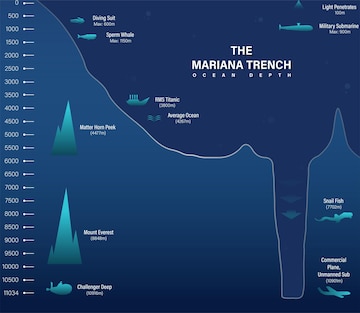
Known deepest point: Challenger Deep, reaching ~36,000 feet (nearly 7 miles) below sea level
Located near: Guam and the Northern Mariana Islands, which give the trench its name
This is a place where sunlight never reaches, pressures exceed 16,000 psi, and temperatures hover just above freezing — the most extreme environment on Earth outside of space.
🌊 Early Encounters: The First Attempts to Measure the Abyss – Mariana Trench History Location
1875 – HMS Challenger
The world’s knowledge of the trench began with the HMS Challenger expedition (1872–1876), the first modern scientific voyage of the ocean.
The crew used weighted rope to measure ocean depth
They recorded the first extreme reading: 26,850 feet
The deep point would later be named Challenger Deep in honor of the ship
Though crude by modern standards, this discovery stunned scientists and opened humanity’s eyes to the ocean’s mysterious depths.
🔬 20th-Century Exploration: Technology Meets the Deep
For decades, the trench remained unmeasured with precision. But new sonar and deep-sea technology in the mid-1900s changed everything.
1950s – Advanced sonar mapping
U.S. and Japanese research teams charted more accurate depths, confirming the trench as the deepest known point on Earth.
1960 – The Trieste Descent
On January 23, 1960, the bathyscaphe Trieste, piloted by
Jacques Piccard and
U.S. Navy Lt. Don Walsh,
reached the bottom of Challenger Deep — the first humans in history to do so.
Their dive reached ~35,800 feet. They reported:
fine sediment on the seafloor
flat terrain
and a single flatfish-like creature (though later studies suggest this may have been a misinterpretation)
This feat would not be repeated for over 50 years.
🎥 21st Century Missions: A New Era of Exploration – Mariana Trench History Location
2012 – James Cameron’s Solo Dive
Filmmaker and explorer James Cameron became the first person to reach Challenger Deep alone, aboard the submersible Deepsea Challenger.
He collected:
high-resolution video
biological samples
geological data
His mission revealed a rich variety of microbial life thriving in the extreme pressure.
2019–2023 – Victor Vescovo’s Expeditions
Explorer Victor Vescovo made multiple descents in the DSV Limiting Factor, setting a new depth record of ~35,853 feetand confirming the trench’s shape with unprecedented accuracy.
His dives uncovered:
new species
deep-sea plastic pollutants (a disturbing first)
new mapping of the trench’s topography
These missions proved the trench is not a lifeless void but a dynamic, scientifically rich ecosystem.
🧬 Life at the Bottom: Creatures of the Abyss
Despite the crushing pressure, scientists have discovered life forms adapted to conditions unlike anywhere else on Earth:
Amphipods with transparent shells
Microbes that feed on chemicals instead of sunlight
Snailfish living deeper than any known vertebrate
These organisms help researchers understand adaptation, climate history, and even possibilities for life on other planets.
⚠️ Threats and Human Impact – Mariana Trench History Location
Even in the ocean’s deepest sanctuary, human influence is present.
Explorers have found:
plastic bags
microplastics
chemical pollutants
Though remote, the trench is still affected by global waste cycles — a humbling reminder of humanity’s footprint.
🌏 Why the Mariana Trench Matters
The trench is more than the deepest point on Earth — it is a scientific frontier that teaches us about:
the movement of tectonic plates
the origins of life
the limits of biology
the future of ocean ecosystems
Its depths continue to challenge explorers, inspire researchers, and remind us of how much remains undiscovered.
📜 Our Take: A World Still Unexplored
From the first rope soundings of 1875 to modern submersible descents, the Mariana Trench stands as one of the last great mystery zones of our planet. Its history is still being written, one dive at a time. And even now, with all our technology, more than 80% of the trench remains unmapped and unseen.
It is Earth’s final frontier — a place where the unknown still thrives.
© 2026 LatestBreaking.com Any and all trademarks used herein are hereby acknowledged as the property of their respective owners.
